
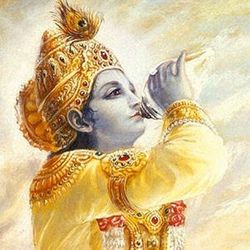

19_Bhagavad Gita: Chapter 2, Verse 45 to 48
ذڪۦۘۘۘﺮﯾۦۘۘۘﭑټﻗۦۘ
Description
<p> All material activities involve actions and reactions in the three modes of material nature. They are meant for fruitive results, which cause bondage in the material world. The <em>Vedas </em>deal mostly with fruitive activities to gradually elevate the general public from the field of sense gratification to a position on the transcendental plane. Arjuna, as a student and friend of Lord Krsna, is advised to raise himself to the transcendental position of <em>Vedanta </em>philosophy where, in the beginning, there is <em>brahma-jijnasa, </em>or questions on the Supreme Transcendence. All the living entities who are in the material world are struggling very hard for existence. For them the Lord, after creation of the material world, gave the Vedic wisdom advising how to live and get rid of the material entanglement. When the activities for sense gratification, namely the <em>karma-kanda </em>chapter, are finished, then the chance for spiritual realization is offered in the form of the <em>Upanisads, </em>which are part of different <em>Vedas, </em>as the <em>Bhagavad-gita</em> is a part of the fifth <em>Veda, </em>namely the <em>Mahabharata. </em>The <em>Upanisads </em>mark the beginning of transcendental life.</p><p> As long as the material body exists, there are actions and reactions in the material modes. One has to learn tolerance in the face of dualities such as happiness and distress, or cold and warmth, and by tolerating such dualities become free from anxieties regarding gain and loss. This transcendental position is achieved in full Krsna consciousness when one is fully dependant on the good will of Krsna</p><p><br></p><p> The rituals and sacrifices mentioned in the <em>karma-kanda </em>division of the Vedic literature are to encourage gradual development of self-realization. And the purpose of self-realization is clearly stated in the Fifteenth Chapter of the <em>Bhagavad-gita </em>
Uploader
eddie.storm
Episodes
19_Bhagavad Gita: Chapter 2, Verse 45 to 48
ذڪۦۘۘۘﺮﯾۦۘۘۘﭑټﻗۦۘ