
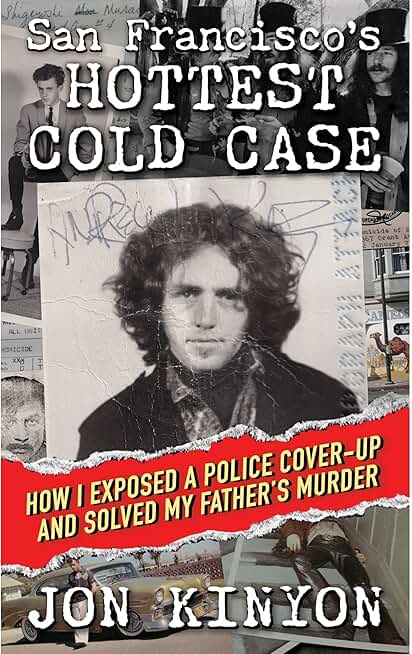

San Francisco's Hottest Cold Case: How I Exposed a Police Cover-Up and Solved My Father's Murder
𝐌𝐚𝐫𝐥𝐞𝐧𝐞 𝐂𝐚𝐫𝐦𝐞𝐧 💌
Description
"Something clearly stinks in how police handled this case."- Tony Serra, famed Civil Rights AttorneyAndy Kinyon was a gifted salesman, a hustler in the best sense of the word. He became the top earner for the publisher of LOOK Magazine at the age of 22 in 1965. That same year, he befriended notable figures like Ken Kesey, Owsley Stanley, and Jerry Garcia. Andy was among the first to join the counter-culture movement in Haight-Ashbury and worked for Bill Graham and Chet Helms, conducting psychedelic light shows for performances by Jimi Hendrix, Janis Joplin, Jim Morrison, and many others.In 1968, as the Haight-Ashbury neighborhood was overtaken by homeless runaways, pimps, and speed dealers, Andy relocated to North Beach. His penthouse apartment became a hub for famous and not-so-famous people alike. Unfortunately, tragedy struck in the early morning hours of January 22, 1972, when he was found stabbed and slashed to death in the stairwell of his residence. Andy was just 29 years old. The killer -or killers- were never brought to justice.Over the next four decades, the San Francisco Police Department (SFPD) refused to let the victim's family access any evidence related to the case. Inspector Frank Falzon, the lead detective, lied to the family about key facts and never revealed the prime suspect’s true identity. To this day, the SFPD continues to obfuscate and cover up the truth about the crime and refuses to run DNA tests on physical evidence.In 2010, Andy's son, Jon Kinyon, took on a 10+ year-long private investigation into his father's murder. Through iron-willed determination and relentless sleuthing, he tracked down long-lost witnesses, discovered disturbing facts, and dug up long-buried evidence. Jon's work ultimately forced the SFPD to finally name the prime suspect as "the person responsible for the death of Andy Kinyon" and close the case.This book is not a typical cold case story or a tale of police corruption. It is a "true-crime memoir,” as James Ellroy calls it, a deeply personal account of the invest
Related Works

Episodes (43)
FOREWORD
INTRODUCTION
CHAPTER 1
CHAPTER 2
CHAPTER 3
CHAPTER 4
CHAPTER 5
CHAPTER 6
CHAPTER 7
CHAPTER 8