
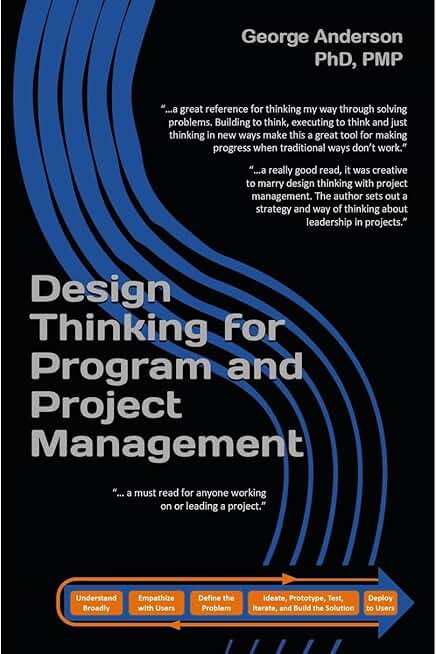

Design Thinking for Program and Project Management
Basabaty Coulibaly
Description
Need to re-invent your career? Interested in becoming a better Project Manager or Leader? Consider learning how to apply Design Thinking techniques to your projects and other initiatives. Discover how to Think differently to Lead more effectively. And become a better problem-solver! Complex problem-solving today requires arming both the problem solvers AND those who Lead and Manage the problem solvers -- from executives to PMPs, PgMPs, managing architects, and other leaders -- with a tool bag of proven transformation-enabling and innovative Design Thinking techniques.Anderson explores more than 70 of these techniques, aligned around the five phases of traditional Program and Project Management and applied through a unique five step Design Thinking model. In this way, he sets the stage for improved time-to-value as he outlines Program and Project Management in the context of broadly understanding, deeply empathizing, defining, solutioning, and finally deploying and realizing value.Sample techniques include Building to Think, considering Adjacent Spaces, Aligning Strategy to Time Horizons, capturing Silent Design outcomes, Probing for Understanding, Divergent Thinking, Empathy Mapping, Persona Analysis, Ideating & Brainstorming, Inclusive & Sensitive Design, Increasing Shared Identity, Day in the Life Analyses, Edge Case Thinking, Story Telling, Modular Building, Prototyping, Iterating, The Five Why’s, Scaling for Effectiveness, Testing to Learn, Simple Rules, Guiding Principles, The Rule of Threes, Premortems, Brainstorming in Reverse, Backporting, and more...This book is about Finishing what we Start and Delivering what we have Promised to our users and our stakeholders. Anderson concludes each chapter with content-specific Guiding Principles. And to reinforce learnings and apply key principles, a simple case study spans each chapter, complete with Questions and Answers. Finally, a robust Appendix of all the applied Design Thinking Techniques concludes the book, along with an invitation to help improve the book t
Creators
Basabaty Coulibaly
Creator