
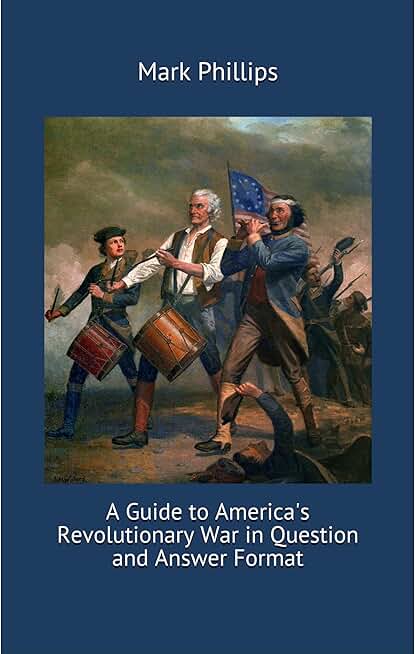

A Guide to America's Revolutionary War in Question and Answer Format
Damas
Description
Originally published as a section of the author’s larger “Conversations in Early American History: 1492-1837,” and equivalent in length to a physical book of approximately 100 pages, this Kindle edition, in easy-to-follow question-and-answer format, clearly explains the causes of the war, describes the key battles, outlines the peace settlement, and profiles the heroes of the Revolution. CONTENTS 1. Lead-Up to the War 2. The War Begins—Lexington and Concord 3. The Declaration of Independence 4. Early Battles 5. The Tide Turns 6. Surrender and Peace 7. Heroes of the Revolution Sample passage: Didn’t Paul Revere have some kind of signal—using one or two lanterns in a Boston church tower—to alert his countrymen of the Redcoats’ arrival? You must be thinking of “one if by land and two if by sea.” Yes. But that doesn’t make sense to me. How could the British come by land? There’s no land route from England to America. The lantern signal didn’t concern British soldiers coming to America from England. It concerned Redcoats who were already stationed in America—in Boston. The question was whether the Redcoats would make their move from Boston to Lexington and Concord by land or by sea. But that doesn’t make sense either. If they were already in Boston and had to go west toward Lexington, how could they have gone by sea? The sea would have taken them back to England. That phrase, “one if by land and two if by sea,” wasn’t actually used by Paul Revere. It comes from the poem by Longfellow. In the phrase, the word “sea” doesn’t refer to the Atlantic Ocean. It doesn’t? No. You see, much of colonial Boston was separated from the mainland of Massachusetts by a river—the Charles River. Only the southern part of the city was connected by land to the mainland of Massachusetts. The Redcoats, who were stationed in Boston, needed to get to a road that led to Lexington. The question was whether they would get to that road by land (by walking first south, then west, then north) or by water (by rowing across the Charles in boats). In t
Uploader
Damas
Related Works

Episodes (7)
CHAPTER 1 : LEAD - UP TO THE WAR
CHAPTER 2 : THE WAR BEGINS — LEXINGTON AND CONCORD
CHAPTER 3 : THE DECLARATION OF INDEPENDENCE
CHAPTER 4 : EARLY BATTLES
CHAPTER 5 : THE TIDE TURNS
CHAPTER 6 : SURRENDER AND PEACE
CHAPTER 7 : HEROES OF THE REVOLUTION