
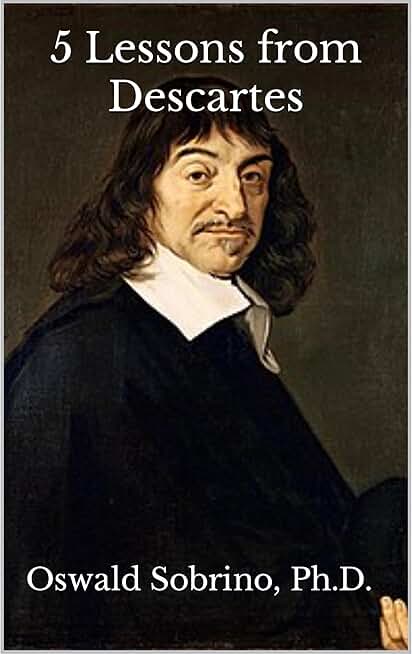

5 Lessons from Descartes
Tejas Kumar Patel
Description
René Descartes (1596-1650) has been commonly known as the "father of modern philosophy" who was also a mathematician and a scientist as the Scientific Revolution was breaking out in Europe. Descartes--a lifelong Roman Catholic educated by the Jesuit order, which in 1548 began its prestigious educational mission in Europe (well before the founding of the Protestant seminary known as Harvard)--nevertheless sought to overturn the traditional Aristotelian science taught by the Jesuits and other Catholic educators. With an obsessive focus on pursuing knowledge marked by certainty, Descartes, a polymath, worked on various scientific projects throughout his life in optics, geometry, meteorology, physics, biology, and psychology. He pursued philosophy, especially metaphysics as the study of fundamental reality, to provide a foundation for certainty in his scientific work. He was indeed a world historical figure marked by a zealous calling to make sense of the world in all its dimensions through scientific study and to propose a grand theory of all reality. Although many of his scientific theories were replaced by those of Newton, Descartes, as scholars have noted, bequeathed a legacy of philosophical themes and topics that are still subjects of debate among philosophers today; and, in addition, Descartes still retains some lasting scientific and mathematical achievements to his credit in the development of optics, algebra, and geometry. He is a seminal figure in the human quest for knowledge who cannot be ignored. This book considers five topics relevant to Descartes's most famous work,Meditations on First Philosophy(1641). The topics include: Descartes's early education, his scientific obsession, certain knowledge, the existence of God, mind and body.Read more
Episodes (6)
Introduction
Chapter 1 Descartes’s Early Education
Chapter 2 Scientific Obsession
Chapter 3 Certain Knowledge (Meditations One and Two)
Chapter 4 The Existence of God (Meditations Three, Four, and Five)
Chapter 5 Mind and Body (Meditation Six)